In 2022 the principal counted 760 students on the grounds, 338 of them in grades 7 to 9 and the rest in the upper secondary grades. Earlier counts were smaller: 477 in 2008, 410 in 2015.
 PROURGN
合同会社プロウン · TOKYO
PROURGN
合同会社プロウン · TOKYO
Menu
For Universities in Cambodia
From a village school in Prey Veng to university in Phnom Penh.
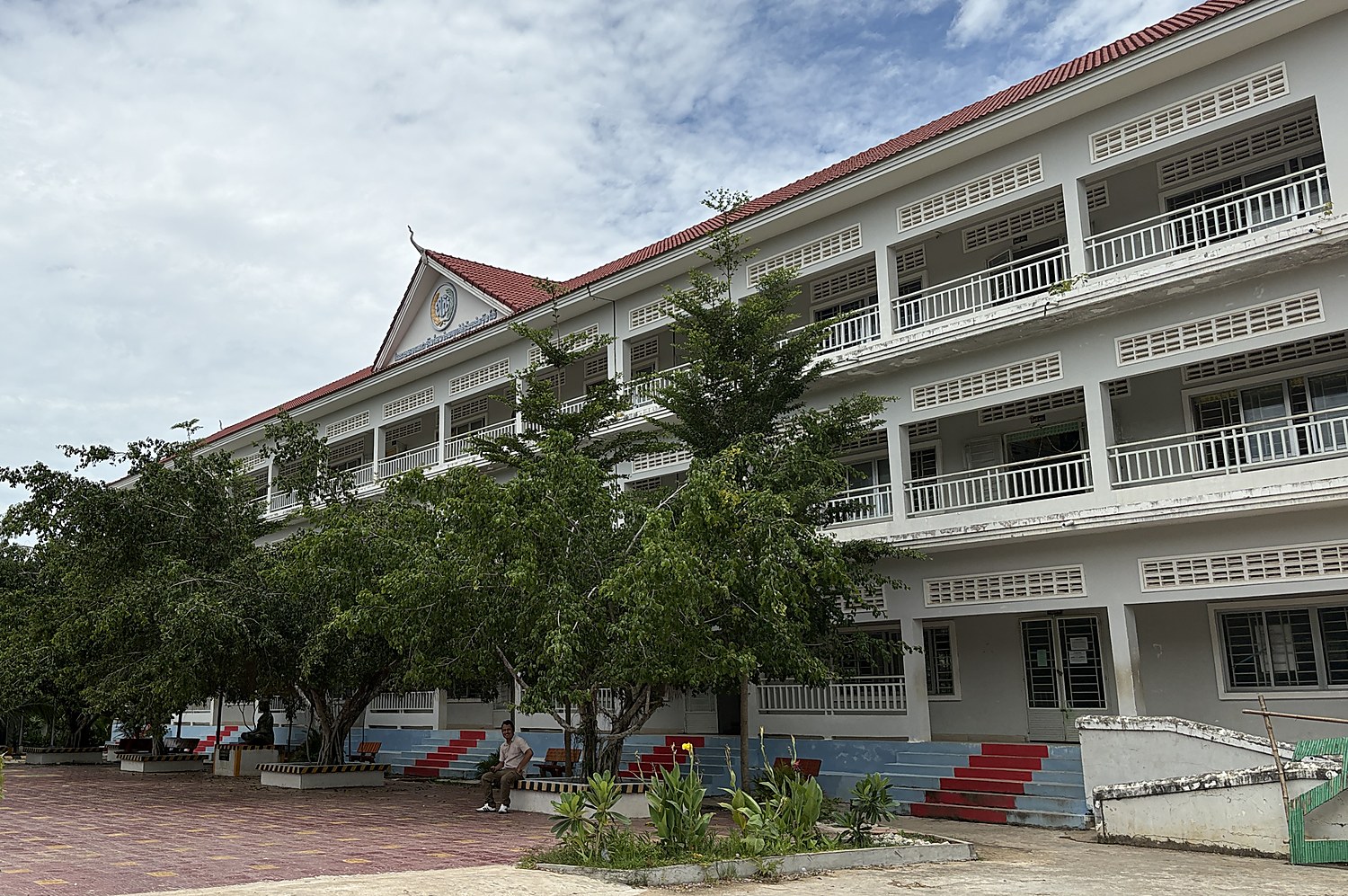
The Rieko Yano School opened in rural Prey Veng in 2006. Twenty years later its strongest graduates are reaching university — and we are looking for universities in Phnom Penh to build that last step with us.
- The Rieko Yano School opened
- 2006
- Grades taught on the same grounds today
- 7–12
- Students, counted by the principal in 2022
- 760
- Rieko Yano's trips to Cambodia
- 1–2 a year
THE PLACE
The school stands in the rice country of Prey Veng.
The Rieko Yano School stands at Kampong Trabek, a district of Prey Veng Province about three hours by road from Phnom Penh. The first site had to be moved some fifteen kilometres when the Mekong flooded it, and the school was built instead beside the paved road that runs down to Vietnam.
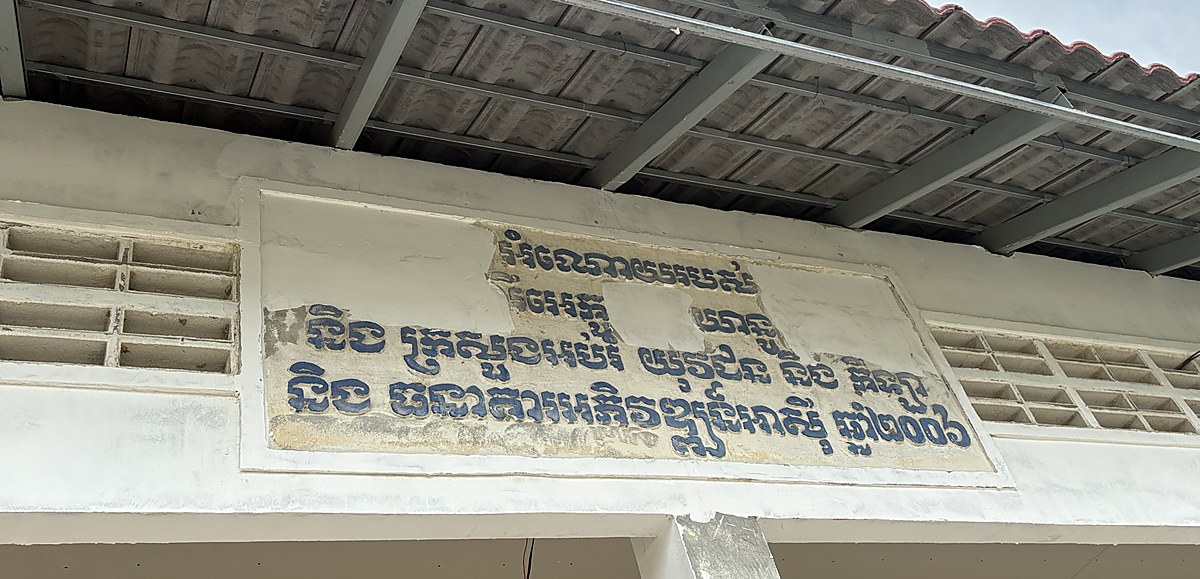
It belongs to the state. The block that carries the school's name was funded in 2006 by Rieko Yano together with Cambodia's Ministry of Education, Youth and Sport and the Asian Development Bank, through the Rural Schools Program of World Assistance for Cambodia, founded by the journalist Bernard Krisher.
It opened as a lower secondary school. Two upper secondary blocks were added on the same grounds in 2017, and the school has taught to grade 12 since 2018.
THE STUDENTS
The students walk or ride in from the farms around the school.
The hard part is not getting them to start. It is keeping them to the end of grade 12, and then finding a way past it.
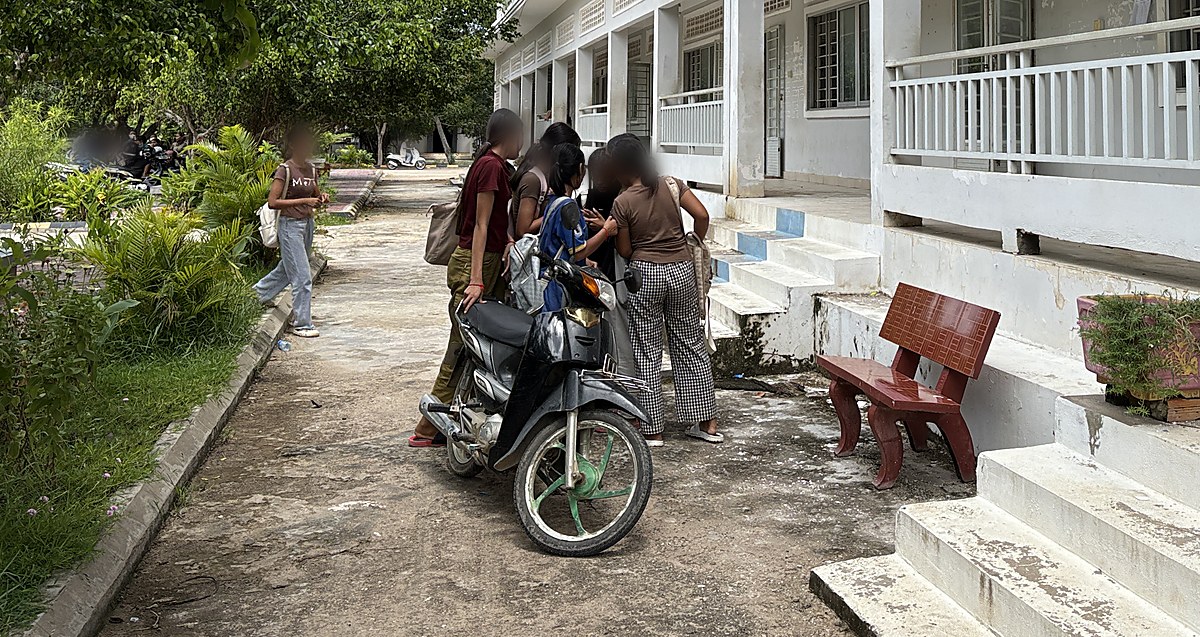
Classes thin as the grades rise. Four classes in grade 7 became two by grade 9, because children are needed at home. Girls have taken most of the places in the finals we have run.
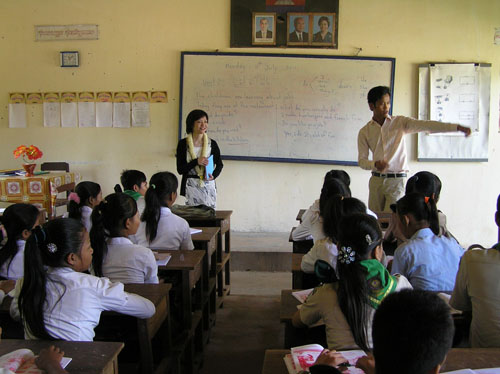
Cambodian teachers, under a principal appointed by the state. They are the people who tell us which students to look at, and they gather the papers.
IN CLASS
English is the subject we have backed the longest.
In 2009 Rieko Yano paid for three solar panels, the school's first two computers, an internet link, and the salary of a teacher of English and computing — renewed year after year. Computer classes followed in 2012.
Between 2015 and 2019 the school ran six English contests, five of recitation and the last of speeches the students wrote themselves. Preliminary rounds drew 27 to 50 entrants, six reached each final, and every student in the school was given a set of stationery.
In 2019 the library took in a hundred illustrated English books and a set of Khmer folk tales; mathematics exercise books for grades 7 to 9 followed in 2020. In February 2022 Cambodia's education ministry ended its agreement with the NGO that ran the English and computer classes, and those lessons stopped.
SINCE 2006
Twenty years, told in what was built and what was paid for.
Not a campaign. One school, the same one, for twenty years — and the work on it is still going on.
- c. 1990A secretary at Cambodia's embassy in Tokyo, learning Japanese, tells Rieko Yano how her father was shot in front of her under the Khmer Rouge.
- 2006The school is funded and built in Prey Veng, with the Ministry of Education, Youth and Sport and the Asian Development Bank, and opens as a lower secondary school.
- 2009Solar panels, the first two computers, an internet link, and the salary of a teacher of English and computing.
- 2011Rieko Yano visits for the first time, for the dedication ceremony. “Having turned up at the opening,” she wrote later, “I could no longer stop.”
- 2012–2017A vegetable garden in front of the school, grown with neighbouring farmers and cooked into school meals for thirty to fifty students a week. Closed in 2017: books and materials mattered more.
- 2015–2019Six English recitation and speech contests, with stationery for every student in the school.
- 2017–2018Two upper secondary blocks go up on the same grounds. The school begins teaching to grade 12.
- 2019–2020English and Khmer books for the library, with a borrowing log and a monthly list of what was read most; mathematics exercise books for grades 7 to 9.
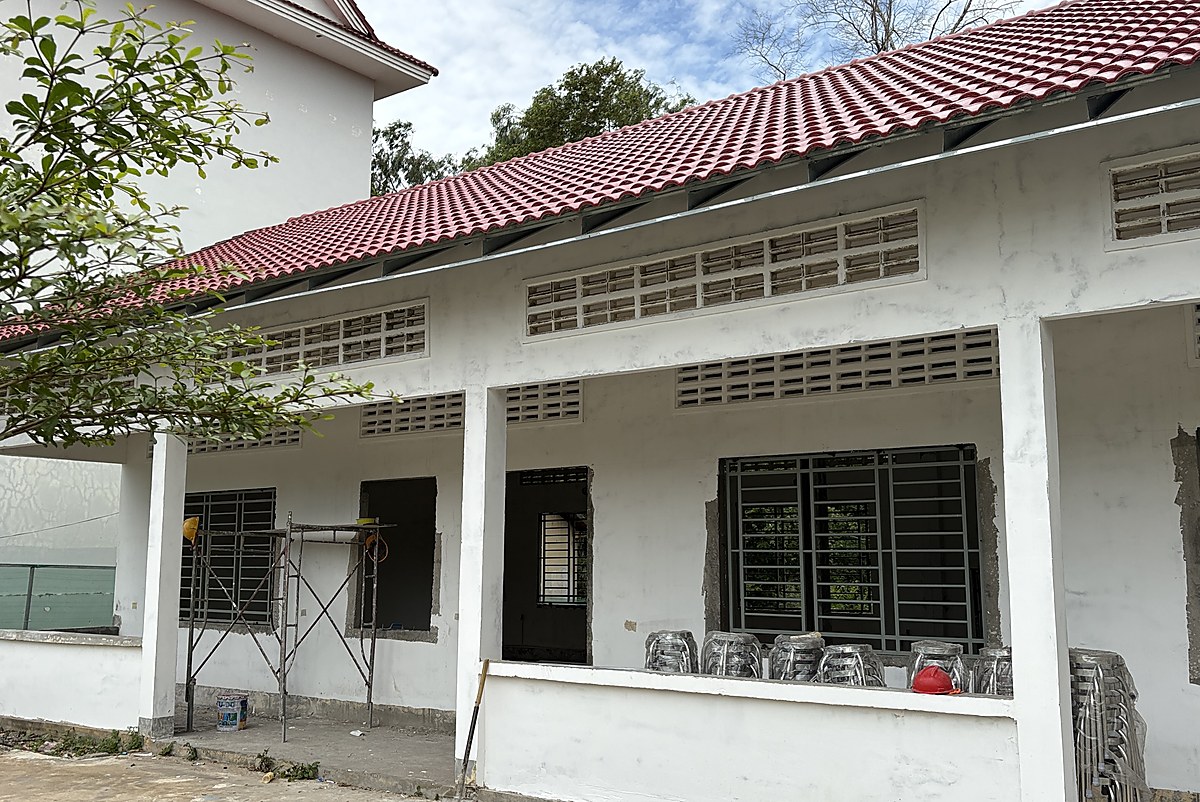
- 2026The 2006 block is stripped back and refitted — new roof, new window frames, floors relaid.
THE RIEKO YANO SCHOLARSHIP
Talent should not stop at the school gate.
For a farming family in Prey Veng, a place in Phnom Penh is a cost, not a prize. The scholarship is meant to remove exactly that obstacle — and nothing is paid before a student holds an admission letter.
Graduates of the Rieko Yano School
Students who do well in Cambodia's national grade 12 examination and are admitted to a university in Phnom Penh. Where no candidate from the school qualifies in a given year, we look to a neighbouring school, or wait.
Nominated locally, chosen in person
The principal and the teachers put names forward and gather the papers. Rieko Yano meets each candidate and decides herself. There is no selection committee.
One year at a time, in writing
Tuition goes straight to the university. Each year is agreed separately, in its own written agreement; we do not commit to a number of years in advance, and what is covered is settled case by case with the student and the university.
- STEP 1National examinationThe grade 12 results come out, and set which university scholarships a student can reach.
- STEP 2University entranceThe student applies and sits the university's own examination.
- STEP 3Admission, then the decisionOnce the admission letter exists, Rieko Yano meets the student and decides that year's support.
- STEP 4A fresh agreement each yearProgress is reviewed with the student, and the following year is agreed on its own terms.
Cambodia's universities attach their own awards to the examination grades, and a student who takes a place at one university cannot hold a scholarship at another. Graduates of the school have gone on to the Royal University of Phnom Penh and the Institute of Technology of Cambodia, some on the university's own award. In July 2026 Rieko Yano met the rector of the University of Health Sciences in Phnom Penh to ask how a private scholarship could sit alongside the university's; the answer was to come back once a student has passed the entrance examination. That is where we are now.
Where the introduction came from: a Cambodian professor met at a healthcare conference in Kolkata in March 2026, through Prourgn's work with iKure in India. The two initiatives are not connected on paper. The people are.
WHAT YOU CAN DO
Three ways to take part, and what the first one looks like.
All three are answered in the same place — the form at the end of this page. Say which one brought you here and Rieko Yano will reply in writing, usually within two working days.
Build the scholarship with us
A private scholarship goes further when it works hand in hand with the university. We would welcome a conversation with admissions, scholarship and international offices. What that looks like in practice is below.
Send books or stationery
Pens, notebooks and books reach every student in the school. The school itself belongs to the state and is supported through World Assistance for Cambodia, so ask us where a gift goes before you send one.
Come and see it
Rieko Yano travels to Cambodia once or twice a year and can take visitors to Kampong Trabek — three hours by road from Phnom Penh, and you stand in the classroom itself.
What working with us on the scholarship looks like
Combine with your own awards
Most universities offer scholarships tied to the national examination grades. Told what yours covers, we can fill what is left instead of duplicating it — and reach more students with the same money.
Paid directly to you
We pay tuition to the university, not to the student, and ask for clear information on fees, the length of the programme, other costs and housing.
One honest check-in a year
A short yearly conversation about how the student is doing. It is what the next year's agreement is built on, so that no scholar quietly falls away.
A line to Japan
Rieko Yano mentors Cambodian medical students and young doctors living in Japan, introduced by their universities. Your students and staff can use that line too.
Get in touch
Ask about the school and the scholarship
Rieko Yano reads every message herself and replies in English or Japanese. She travels to Cambodia one or two times a year and can take visitors to the school.